Web Design for Trekking and Travel Agencies in Nepal
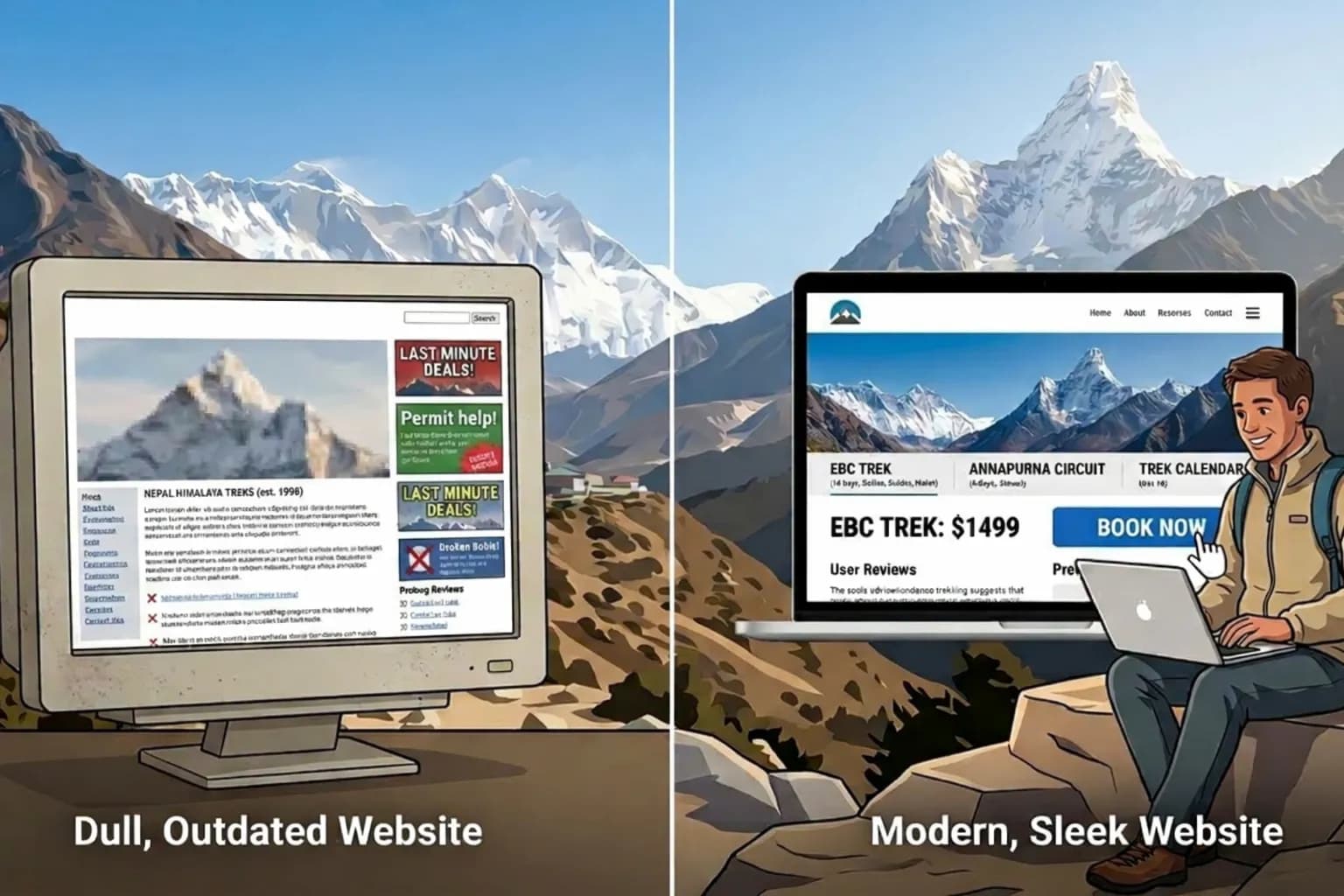
A customer is sitting at home in the USA, planning their dream trek to Everest Base Camp. They search on Google: "Best Everest Base Camp trek package." They find three websites. Two look professional. One looks outdated. Which one do you think they will choose?
Or imagine a traveler wants to book an Annapurna Circuit trek. They need to trust the agency. They need to see photos. They need to read reviews. They need to see clear pricing. They need to be able to book easily.
A good website does all of this. A bad website loses the customer.
In Nepal, tourism is booming. In 2025, Nepal welcomed 1.158 million tourists. This is a record. Tourism is growing 20% year after year. Trekking companies are the heart of this tourism.
But here's the reality: Not all trekking and travel agencies have good websites. Some have no website at all. Some have websites that don't work properly. Some have websites that don't get bookings.
This is a huge opportunity for you.
A professional website is not a luxury anymore. It's how customers find you. It's how they book with you. It's how you compete.
In this article, we will explain everything you need to know about web design for trekking and travel agencies. We will explain why your website matters. We will explain what features you need. We will explain how to convert visitors into customers.
The Tourism Boom is Real - And Customers Are Online
Nepal's Tourism is Exploding
Nepal is experiencing a tourism boom like never before. The numbers prove it:
1.158 million tourists visited Nepal in 2025. That's one million people. Looking for trekking packages. Looking for tours. Looking for guides. Looking for agencies.
This number is growing every year. From 2024 to 2025, tourism grew by 20%. That's huge growth.
And experts predict Nepal will cross 1.5 million visitors by 2026.
Where are these tourists coming from?
-
22% from India - close neighbor, growing market
-
8.6% from the USA - Americans love adventure
-
7.8% from China - huge market potential
-
5.8% from UK - adventure enthusiasts
-
4.6% from Bangladesh - close region
All these customers are looking for trekking agencies. Online.
These Customers Search Online First
Here's the key fact: 81% of travelers research online before booking any travel service.
They don't just call. They don't just ask friends. They search on Google first.
What do they search for?
"Best Everest Base Camp trek package"
"Annapurna Circuit trek cost"
"Nepal trekking companies reviews"
"Mustang trek itinerary"
"Reliable trekking guide in Nepal"
If your website is not showing up in these searches, customers go to your competitors. This is exactly why investing in SEO services in Nepal is as important as building the website itself.
And most people never look past the first page of Google. If you're not on page 1, you're invisible.
Mobile is How Travelers Browse
Here's another reality: 73% of all web traffic comes from mobile phones.
Travelers are not sitting at desktops. They are:
-
Browsing on their phones
-
Checking reviews on the go
-
Comparing prices on mobile
-
Booking on their phones
Your website must work perfectly on mobile. If it doesn't, customers leave.
Half of mobile visitors leave if a page takes more than 3 seconds to load. Your website must be fast.
Tourists Want to See Beautiful Photos
Travelers book based on emotion. They see a beautiful photo of Everest. They read an inspiring review. They feel excited. They want to book.
A website with poor photos, no videos, and a boring design doesn't inspire anyone.
A website with stunning photography, professional design, and clear information inspires trust.
Why Trekking & Travel Websites Are Different
Travel websites are not like other websites. They have unique requirements.
Complex Decision-Making
Booking a trek is not like buying a shirt. It involves:
-
Which trek? (Everest, Annapurna, Manaslu?)
-
When? (Spring or Fall?)
-
How long? (10 days? 20 days?)
-
Budget? (Luxury or budget?)
-
Difficulty? (Easy or challenging?)
-
What's included? (Guides? Food? Accommodation?)
-
Safety? (Will I be safe? Professional guides?)
Customers need to compare. They need information. They need reassurance.
High-Value Purchase
A trek is expensive. Not 500 NPR. Could be thousands or more.
When spending serious money, customers need trust. They need reviews. They need to see who is behind the company.
A bad website = no trust = no booking.
Emotional Purchase
People don't book treks for logical reasons. They book because of emotion.
They dream of standing at Everest Base Camp. They want to experience nature. They want adventure. They want a transforming experience.
A good website taps into these emotions. A bad website just shows prices.
Multiple Review Sources
Travelers check reviews everywhere:
-
Your website testimonials
-
Google Reviews
-
Facebook reviews
-
Instagram
-
Online review sites
Your website must showcase these reviews prominently.
Visual Inspiration Needed
More than any other industry, travel websites need beautiful visuals.
A poor photo loses a booking. A stunning photo wins a booking.
Essential Features Every Trekking Website Must Have
Now let's talk about what your website needs to work.
Trust Signals & Credentials
Travelers want to know who they're trusting with their money and safety.
- Company Information
- Certifications & Licenses
- Safety Information
- About the Guides
- Certifications
Want to see how trust-building design looks in practice? Check out websites we have built for businesses in Nepal.
Design Principles for Travel Websites
Good design is not just beautiful. Good design sells. Effective UI/UX design guides your visitors step by step from browsing to booking.
|
Principle |
Key Idea |
What to Do |
|
Lead with Emotion |
First impression should inspire |
Use real, stunning trek photos (not stock) |
|
Clear Navigation |
Easy to find info |
Simple menu: Home, Treks, About, Reviews, Blog, Gallery, Contact |
|
Clear Hierarchy |
Highlight important info |
Emphasize trek name, show difficulty, highlight price & CTA |
|
White Space |
Keep the design clean |
Avoid clutter, improve readability, and focus |
|
Consistent Branding |
Uniform look across site |
Same colors, fonts, logo, buttons, photo style |
|
Call-to-Action Buttons |
Encourage action |
Use bright, clear buttons like “Book Now,” placed multiple times |
|
Urgency & Scarcity |
Motivate booking |
Show real limited spots, deadlines, or offers |
Technical Requirements for Performance
A beautiful website that's slow is useless. Technical performance matters.
|
Requirement |
Key Goal |
Why It Matters |
|
Fast Loading Speed |
Load under 3 seconds |
Reduces bounce rate, improves SEO, and increases conversions |
|
Mobile Optimization |
Mobile-first experience |
Most users are on mobile, better user experience |
|
SEO Optimization |
Rank on Google |
Drives organic traffic and visibility |
|
Security (SSL) |
Safe user experience |
Builds trust, protects user data |
|
Analytics & Tracking |
Understand user behavior |
Helps improve performance and increase bookings |
Conversion Optimization - Turning Visitors into Customers
Having a website is not enough. The website must convert visitors into bookings.
|
Strategy |
Key Idea |
|
High-Quality Photography |
Use real, professional photos and videos to create emotional impact |
|
Social Proof (Reviews) |
Show real testimonials with photos, names, and ratings |
|
Simplify Booking |
Keep the booking process quick and easy with minimal steps |
|
Multiple Contact Options |
Offer WhatsApp, chat, phone, email, and forms |
|
Personalization |
Recommend treks and tailor the user experience |
|
Testimonial Videos |
Use real customer videos for stronger trust |
|
FAQ Section |
Answer common questions to reduce doubts |
|
Trust Signals |
Show experience, certifications, and safety info |
|
Email Follow-Up |
Stay in touch with interested customers to convert them |
|
Retargeting |
Re-engage visitors with ads and special offers |
Content That Converts
What you write matters as much as design.
Homepage Copy
Should answer:
"What can I do here?" (Book trekking packages)
"Why should I trust you?" (Years of experience, reviews)
"What are my options?" (Show 3-5 popular treks)
"How do I get started?" (Clear CTA)
Trek Page Copy
Should explain:
-
What is this trek?
-
Who is it for?
-
What will I see?
-
What's the challenge?
-
What's included?
About Us Page
Should communicate:
-
Who are you?
-
Why did you start this business?
-
What's your mission?
-
What's your experience?
-
Who is your team?
Call-to-Action Copy
Good CTA examples:
"Plan Your Adventure"
"Book Your Trek"
"Get Free Consultation"
"See Available Dates"
"Download Itinerary"
SEO Strategy for Travel Websites
Google is where customers find you.
|
Category |
Key Points |
|
Keyword Strategy |
Target keywords for Everest, Annapurna, and general Nepal trekking searches |
|
On-Page SEO |
Use keywords in titles/headings, write quality content, add links, images, and meta descriptions |
|
Content Strategy |
Create blogs on treks, tips, culture, fitness, and guides to drive traffic and build trust |
|
Link Building |
Get backlinks from travel sites, directories, reviews, and blogs to boost authority |
Marketing Your Website
A great website means nothing if people don't know it exists.
|
Strategy |
Key Idea |
|
Google Ads |
Pay for top search visibility to get immediate bookings |
|
Social Media Marketing |
Share photos, tips, and offers to build an audience and drive traffic |
|
Email Marketing |
Send newsletters and offers to build loyalty and conversions |
|
Partnerships |
Collaborate with travel businesses and influencers to reach new audiences |
|
Content Marketing |
Create blogs, guides, and videos for long-term traffic and authority |
Common Website Mistakes to Avoid
Mistake 1: Poor Photography
Bad photos = lost bookings. Invest in good photography.
Mistake 2: Slow Website
Slow website = lost visitors. Optimize speed.
Mistake 3: Not Mobile-Optimized
Most visitors are on mobile. Make sure it works perfectly on phones.
Mistake 4: Too Many CTAs
Confuses visitors. Use 1-2 main CTAs per page.
Mistake 5: No Social Proof
Reviews are critical. Show them prominently.
Mistake 6: Unclear Pricing
Hidden prices frustrate customers. Be transparent.
Mistake 7: Hard to Contact
Make it easy to book or inquire. Multiple contact options.
Mistake 8: No Mobile Number
Customers want to call. Include your phone number prominently.
Mistake 9: Outdated Content
Fresh content helps Google ranking. Update regularly.
Mistake 10: No Blog
A blog helps with Google ranking and customer questions.
Common Questions About Travel Websites
1. How long does it take to build a trekking website?
A simple 5-page website for a local guide can be ready in 2 to 3 weeks. A professional website with a booking system, blog, and full trek pages typically takes 2–3 months. The timeline depends on how quickly your content (photos, itineraries, pricing) is ready. The more prepared you are, the faster it gets done.
2. How much does a trekking agency website cost?
It depends on what you need. A basic informational site costs less. A mid-range site with booking inquiry forms, 10–15 trek pages, and a blog costs more. A full custom site with payment integration, multi-language support, and live chat sits at a higher budget. The key is to match your website investment with your business scale. Start simple, scale later.
3. Do I need an online booking system?
Not always required to start, but highly recommended. Even a simple inquiry form connected to your email and WhatsApp makes a big difference. Customers want to contact you instantly. A full booking system with payment integration works best for high-volume agencies.
4. Should I show my prices on the website?
Yes. Hiding prices frustrates customers and drives them to competitors. Show base prices clearly, and explain what's included and what isn't. "Starting from $X" works well if pricing varies by group size or season.
5. What contact options should I offer?
Offer multiple options: WhatsApp, phone number, email, inquiry form, and live chat if possible. Many international travelers prefer WhatsApp for quick questions before booking. Your phone number should be visible on every page, especially the header.
6. Can customers book directly through my website?
Yes, if you integrate a payment gateway. Stripe and PayPal work for international customers. For a simpler setup, use an inquiry form that collects trip details and lets you follow up with a custom quote. Many Nepalese agencies use this hybrid model successfully.
7. How do I get customers to find my website on Google?
Through SEO (Search Engine Optimization) and Google Ads. SEO takes time but brings free traffic in the long term. Google Ads provides immediate visibility but incurs a per-click cost. The smartest approach is to run both: Ads for quick bookings, SEO for long-term growth.
8. What makes customers trust a trekking website?
Trust is built through five things: real customer reviews (with names and photos), clear licensing from the Nepal Tourism Board, transparent pricing, professional guide bios with certifications, and a visible phone number or WhatsApp contact. Customers are spending serious money they need to feel safe before they book.
9. Should I display my Nepal Tourism Board registration?
Absolutely. Your government registration number, trekking licenses, and any safety certifications should be displayed prominently, ideally on the homepage footer and the About page. International travelers specifically look for this before trusting an agency.
10. Should I add a mobile app later?
Not in the beginning. Focus on a fast, converting website first. A mobile app makes sense only after you have consistent booking volume and an established customer base. For most Nepal trekking agencies, a well-optimized website is all you need.